

Tusla says it's an offence to run an unregistered children’s home, but it places children in them anyways
So how does it square the circle?
It's generally more environmentally friendly to renovate existing buildings than to abandon them to the wrecking ball, but other public organisations could follow suit.

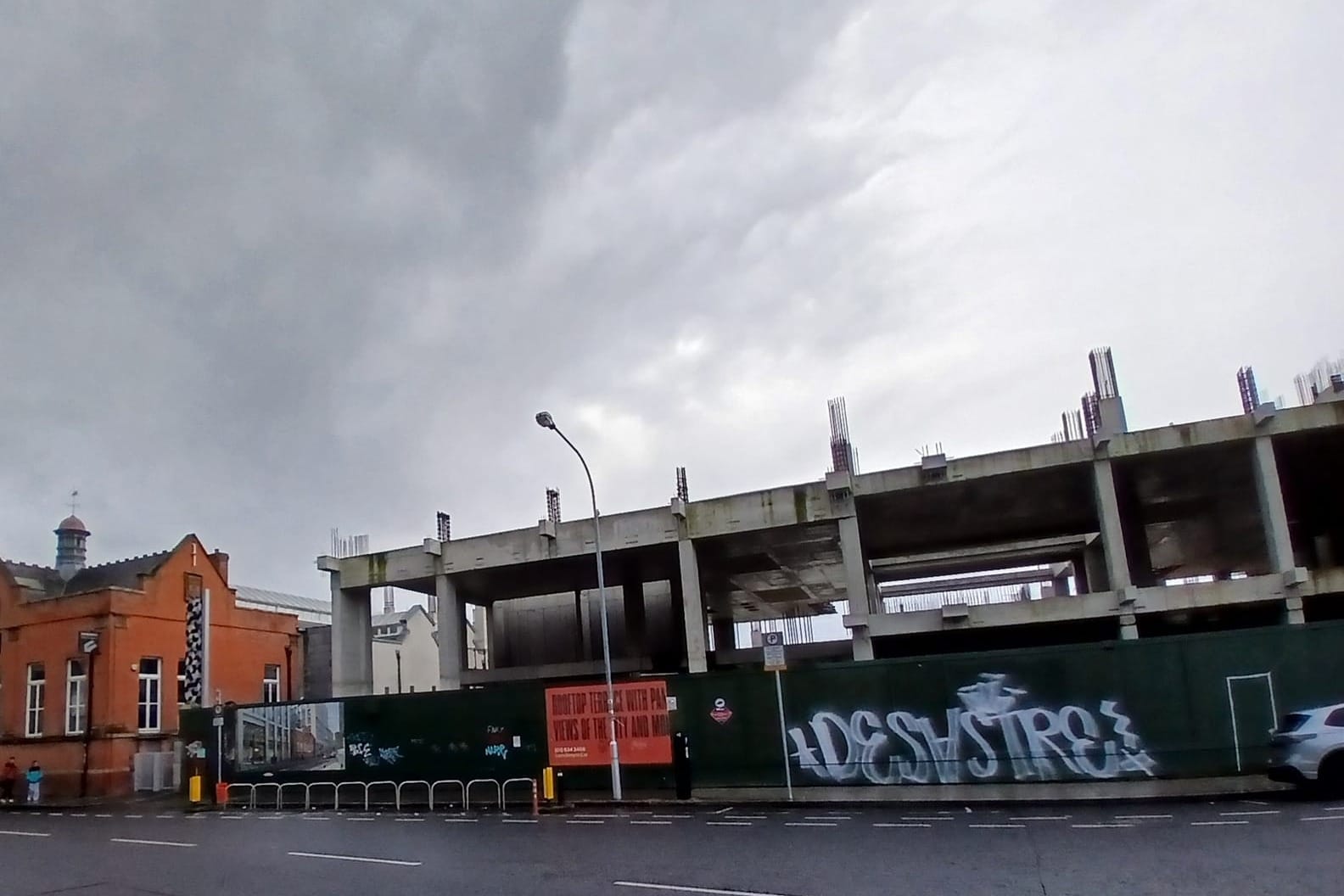
Dublin City Council is pushing ahead with plans to buy the Camden Yard site on Kevin Street with a view to moving its offices there and leaving behind existing big buildings completed in 1981 and 1994 at Wood Quay.
The council chief executive Richard Shakespeare said on Wednesday that the council plans to buy and develop the Camden Yard site using capital spending, and borrowing, and that no other capital projects will be affected.
Shakespeare has said that the council needs to move for sustainability reasons, as the cost of retrofitting its current civic offices to meet its climate commitments could cost up to €400 million.
There’s a looming government target for all public buildings to achieve a minimum BER rating of B by 2030. In 2019, the Civic Offices' BER was D1, though it's unclear whether that has since changed.
But Dublin City Council refused to release three recent reports examining the energy performance of the Civic Offices buildings at Wood Quay, or reports that examine the cost of refurbishing the four blocks of offices.
The council knocked back a request under the Freedom of Information Act, saying that the reports are commercially sensitive and that releasing them could affect the council’s internal deliberative processes, among other reasons.
It released one report, an energy audit from 2019, which outlined lots of potential ways to save energy at Civic Offices, including replacing air conditioning units, pumps, light bulbs and adding more solar panels on the roof, among other things.
Estimates using Society of Chartered Surveyors Ireland data put the cost of retrofitting Civic Offices much lower than €400 million, but without the detailed reports it’s impossible to know the full state of the buildings.
There are lots of ways to improve the energy ratings of old office buildings, says Jeff Colley, editor of Passive House Plus, a magazine about sustainable buildings.
Rather than leaving the buildings and knocking some or all of them to make way for social housing, as Shakespeare has said he plans. “The more sustainable thing to do would be to find a use for that building,” says Colley. “The public bodies should be showing leadership.”
Colley says the “embodied carbon” in building unnecessary buildings far outweighs the emissions savings from new buildings being more energy efficient.
Embodied carbon is the amount of carbon dioxide emissions that come from building materials, across its whole lifecycle from the extraction of raw material, manufacturing, transportation, construction and maintenance.
The Department of the Environment didn’t respond before publication to a query as to whether other public bodies might also use the incoming target as a reason to move to shiny new buildings, abandoning old offices to the wrecking ball – and the potential environmental consequences of all that wastage.
Dublin City Council has also said it is strapped for cash, so it’s not immediately clear where the money is going to come from.“I don’t think the financial element has been explained,” says Green Party Councillor Donna Cooney.
But some councillors are backing Shakespeare’s plans. “It's a bold move,” says Independent Councillor Mannix Flynn. “This has colossal potential.”
He would like to see the Viking ruins at Wood Quay fully excavated, and a walking route from Thomas Street to Temple Bar opened, he says.
And the council could build lots of social and affordable housing on both sites, says Flynn – a point Shakespeare has also been making, when pitching his plan to move the council’s headquarters.
Dublin City Council is set to hike social housing rents in April. It raised the local property tax last year and increased commercial rates, too.
The council justified all those hikes, saying that it is desperate for funds, so it's not immediately obvious how it can afford to buy Camden Yard, for a mooted €80m to €100m.
Shakespeare, the council CEO, said he will use capital funding and borrowing to secure the site, which has foundations and some construction work completed.
The council’s capital funding is already allocated in the capital programme to various projects for roads, housing, flood protection and cultural and recreational projects, including sports facilities, new libraries and the like.
Council borrowing is strictly capped at the moment at €118m a year for all 31 local authorities put together, and Dublin City Council already needs to borrow for long-planned housing developments, and other projects such as the Smithfield Fruit and Veg market.
There is talk of the central government raising that cap, but that is still early stages.
Cooney, the Green Party councillor, says that councillors need more information about where the council is getting the money to buy Camden Yard. “It could be that this is the right thing to do, but without having all the information, we cannot decide.”
She has been told that there is no capital funding available to build an outdoor swimming pool at George’s Dock, she says. (Although a water feature at that location has been promised since before the white water rafting plan was pitched in 2019.)
Flynn, the independent councillor, says the council has money and it could sell other assets if necessary; it owns land elsewhere in the city and valuable car parks in town.
As he tells it, the project is going ahead. “This is a done deal,” says Flynn. “It will be done and dusted by the end of April.
Sinn Féin Councillor Mícheál Mac Donncha says that councillors have yet to get a date for a promised briefing on the plans, but from speaking to some senior officials, he thinks they intend to proceed.
The council executive says its plan includes the construction of social and affordable housing on both sites, though it is unclear who might build that or where the funding for that housing might come from.
“Dublin City Council remains in exclusive discussions regarding the potential acquisition of the Camden Yard site,” says a council spokesperson. “The due‑diligence process is ongoing. No decisions have been made on the acquisition, funding approach or impacts on the capital programme.”
The potential purchase will be subject to due diligence, she says.
A spokesperson for the Department of Public Expenditure says that deciding what to do is up to the council’s CEO.
The Department of Housing spokesperson said the same. “Any proposal in respect of Dublin City Council headquarters is solely a matter for the local authority.”
 Lois Kapila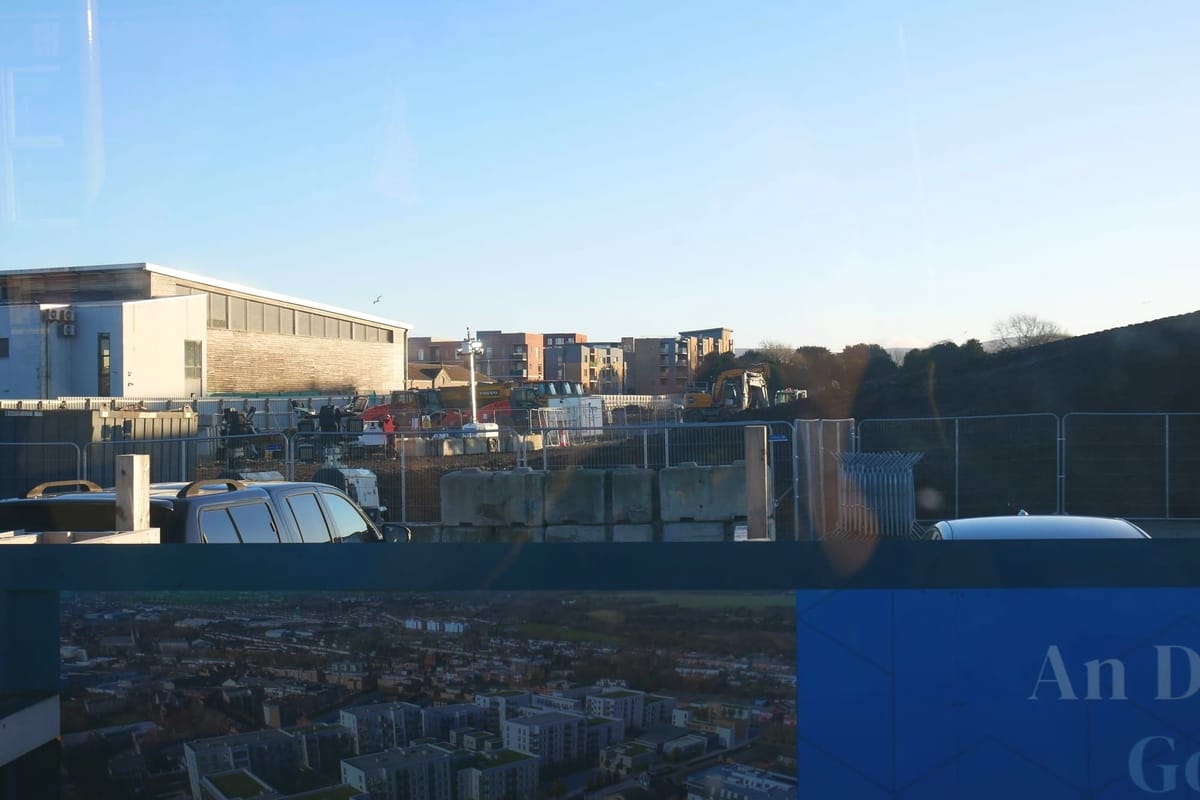
The Wood Quay offices are made up of four blocks with connecting walkways and atriums, in total 40,000 sqm of offices.
Facing onto the quays and backing onto a green area and amphitheatre, with Christ Church Cathedral behind them.
Cooney says she thinks the offices could be renovated, as does her Green Party colleague, former MEP Ciarán Cuffe.
Flynn, the independent councillor, says that the building at Wood Quay needs a lot more work than retrofitting. “The Wood Quay offices are not fit for purpose.”
Dublin City Council said it would cost around €350m to €400m to renovate its Wood Quay offices, that is a “high-level estimate reflecting the potential scope of refurbishment works, including compliance upgrades, sustainability measures, and modernisation requirements”, says a spokesperson.
The Society of Chartered Surveyors of Ireland (SCSI) published a report on the real cost of retrofitting office blocks in April 2025.
Civic Offices are 40,000sqm. Using the highest estimate from the SCSI for a building in poor condition at €1,462 per sqm that would suggest around €58.5m for hard costs, meaning the actual construction work.
Assuming perhaps 20 percent for soft costs, like professional fees, architects, engineers and advisors, would give a price tag 0f €70.2m for the total retrofitting of the offices.
So why is the council's estimate so far out of line with the SCSI figures?
“In relation to the Wood Quay Civic Offices, the figure referenced by the Council reflects an internal high‑level estimate of the cost of fully retrofitting the complex to meet the Council’s climate commitments and future accommodation needs,” she says
It is always better for the environment to re-use existing buildings rather than to demolish them, where possible, says Colley, editor of Passive House Plus.
Both the EU and national government rules are designed to lower carbon emissions, he says, but knocking down buildings and rebuilding new ones is hugely energy-intensive.
“We need to look at carbon emissions from construction,” he says. “There was a huge amount of carbon released into the atmosphere to build that in the first place.”
 Laoise Neylon
As more energy sources are becoming renewable, the spotlight should turn on the carbon released by building and the materials that go into that, he says. There should be more scrutiny on whether a new building is strictly necessary, he says.
A life-cycle assessment is needed for the existing buildings, says Colley. A council spokesperson said that it has completed an assessment.
“I would prefer renovation to relocation,” says Cuffe, a former Green Party MEP for Dublin, who was involved in writing an EU directive, which demands public bodies renovate old offices to reduce carbon emissions.
Cuffe says that the directive insists that public bodies upgrade the worst-performing office buildings, with the lowest 16 percent to be completed by 2030.
He is not convinced the Civic Offices fall in that category, though – he visited them regularly when he was a councillor up to 2019. “I would have thought Wood Quay wasn’t that bad in the larger scheme of things,” says Cuffe.
The Irish government has set a target for all public buildings to achieve a minimum BER rating of B by 2030, but Cuffe says that the EU directive doesn’t stipulate that public bodies should reach a specific BER rating.
To go from an E rating to a C rating would be considered a success, he says, and it isn’t always super complicated to get there. “Sometimes all you need to do is change the boiler.”
“Public bodies should lead the way,” says Cuffe. Emissions targets and directives didn’t intend for public bodies to abandon usable buildings. “The targets are for renovation,” he says.

So how does it square the circle?

But while the numbers of foxes in cities has been steadily creeping upwards, is it a problem or, if humans respond right, a boon?

Richard Shakespeare recently held a closed-doors briefing for councillors, giving them a presentation that was watermarked so they could be caught if they shared it.

Council officials want to keep renting it for about the next five years to the wastewater plant operators.