

Tusla inspectors found problems with the use of physical restraint in seven children’s homes
In two cases, inspectors found that staff were using restraint to try to manage children’s behaviour, and one of those children was restrained 78 times.
But there’s only so much the masjid can do to police people’s bad parking – and it’s not just masjid-goers, it’s everybody, says Fazel Ryklief.

On Friday at noon, strings of cars lined a stretch of South Circular Road in Dublin 8.
Outside the street’s Dublin Mosque, and on the nearby avenues, there are more tight huddles of automobiles.
A few traffic cones stood on the pavement outside the masjid, seemingly to combat footpath parking.
Before Jumma prayers started that day, the imam brought up one case of unruly parking that staff had noticed, said Fazel Ryklief, a senior employee of the masjid, later.
“The imam said, ‘There’s a car, this registration, it’s parked in the wrong place, it’s affecting our neighbours,’” said Ryklief, sitting in a tiny office on Friday.
Parking issues have cropped up in reviews left for the masjid on Google over the years.
“A very well managed mosque, just need more parking spaces the council needs to facilitate,” reads one from two years ago.
That was before the temporary closure of a masjid in Clonskeagh earlier this year, over directorship disputes that became the centre of an ongoing case still trudging through the court.
Since the closure, many of the Clonskeagh masjid’s former visitors who now travel to South Circular Road to pray face the parking constraints locals have long navigated. Their cars add to the strain, too.
Ryklief said he was bracing for the worst when the Clonskeagh masjid closed, but it hasn’t been as bad as he’d expected. Still, he said, neighbours sidle up to him on the street to say, ‘We are praying that the mosque in Clonskeagh will open,’” he said.
On 19 November, a Social Democrats councillor for the area, Lesley Byrne proposed a motion at the South Central Area Committee to look for solutions to sundry problems on the streets around the masjid, from illegal parking to traffic congestion.
During the committee meeting that day, she said that racist outbursts had begun to roll in about these parking and traffic issues.
“I see this is becoming a racist, a race issue. Some of the reps that I’m getting are starting to use language that is completely racist and inappropriate," said Byrne.
Ryklief, of the South Circular Road masjid, said they can only do so much to police people’s bad parking practices – and it’s not just masjid-goers, it’s everybody. “I mean, it seems like we are being picked on.”
Byrne’s motion thrust into spotlight, yet again, persistent problems with poor enforcement of parking rules in the city, and also a dearth of suitable places to pray for minority faith groups.
Michael Pidgeon, a local Green Party councillor, said that when he lived in London, there were a couple of cathedral-like mosques, but “then most people just went to their local one”.
Here, that option isn’t always there, as some local ones are tiny prayer halls that can’t accommodate more than a few dozen congregants, and are often transient rentals.
“Large unmanaged pedestrian gatherings and informal trading obstructing footways and carriageways, creating serious safety hazards” were among the issues that Byrne’s motion said residents had been reporting.
On Friday, signs on the masjid’s gates urged worshippers not to mill about on the street after prayers. “Please respect our neighbourhood,” it said in black text against a yellow backdrop.
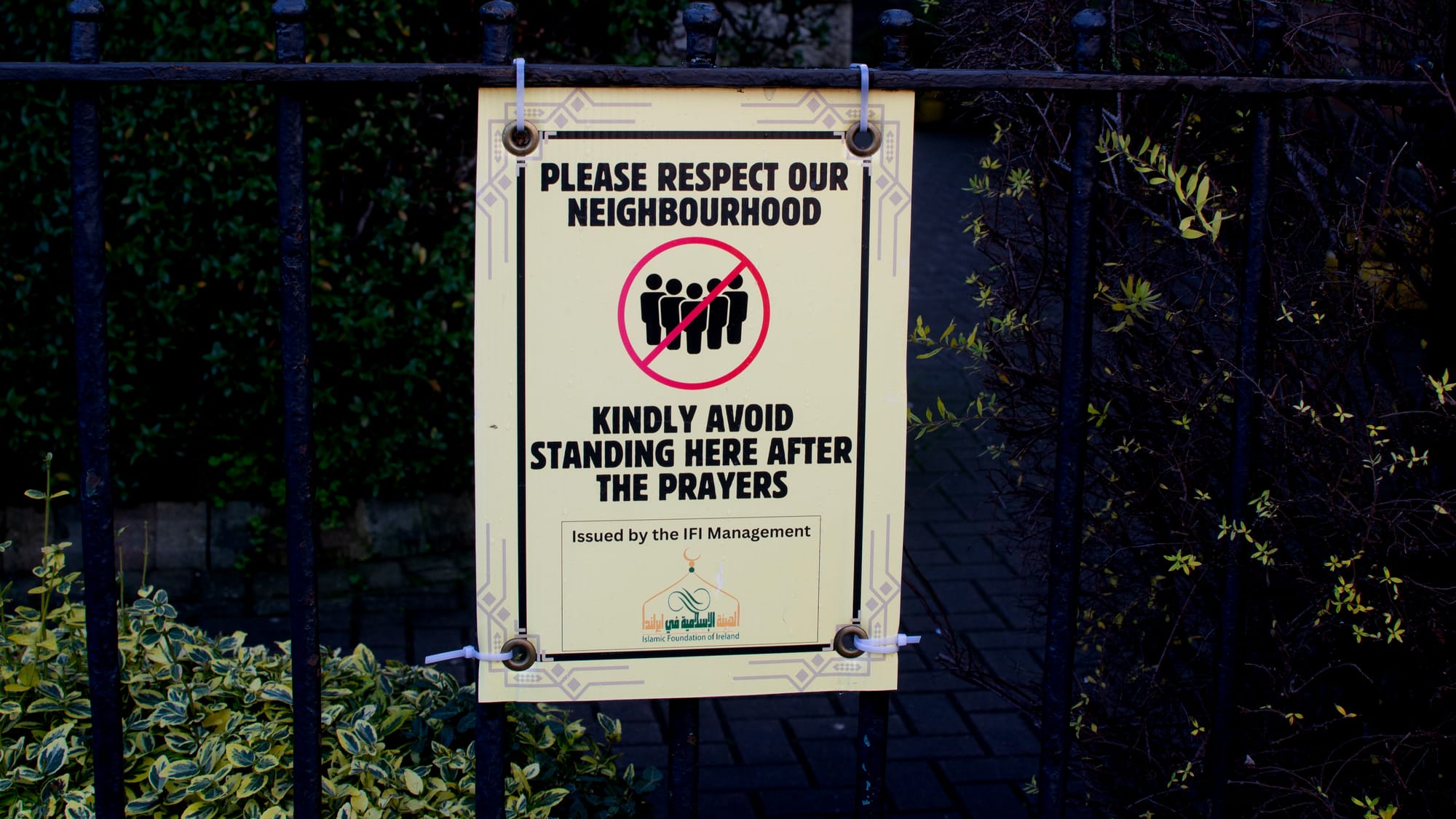
Ryklief said that doesn’t happen in wintertime anyway because the prayers don’t spill into the evening. On Friday, there wasn’t any congregation outside the masjid after prayers.
A man wearing a coat over a dishdashah sat in his taxi near the masjid, taking a swig from a can of Coke and clutching a sandwich.
Another dishdashah-clad man stood with a guy outside a Mediterranean grocer on the street, gabbing and chuckling.
It’s not just the masjid that residents complain brings parking problems to the area.
Locals and councillors have also raised parking issues spilling out into the neighbourhood from the nearby National Stadium when there’s a big event there, some councillors said at the committee meeting in late November.
And there’s going to be more of that with Christmas gigs in full swing, they said.
“I suppose the issue that’s being raised now is specifically the mosque,” said Darragh Moriarty, a Labour Party councillor for the area.
But some of the complaints about the masjid have a different tone to the parking-related ones about stadium-related parking problems.
Anti-immigrant accounts on social media had sometimes taken issue with the presence of Muslims in the neighbourhood, or if people looked like they were Muslims on the bus going towards the masjid, even before attendance grew.
“Dublin 8 is destroyed with muslims. The buses going down the South Circular Road are like buses in Bangladesh,” says a post on X from April 2024, which goes on using dehumanising language to describe the presence of men and women around the masjid.
A late 2023 video on Telegram, seemingly filmed by someone slowly driving by, shows congregants trickling out, strolling, or standing on the sidewalk.
“South Circular Road Dublin … We need to keep our country homogenous … Beginning to look like London or some other captured English city. #IrelandIsFull,” it’s captioned.
Ultimately, said Moriarty, the Labour councillor for the area, we shouldn’t lose sight of the fact that “this is a place of worship and people want to come to us to practice”.
Not a day goes by without staff telling people to be mindful of parking and gathering, said Ryklief of the South Circular Road masjid.
“We try our best to be nice to our neighbours,” he said.
Ryklief has worked in the masjid for so long that he remembers strolling up to work in 1997 and seeing a fire truck outside the gates because someone had tried to burn it down.
In the past, he said, they had asked the National Stadium to let masjid-goers use their car park, but it’s not available at the moment.
“The last time we asked them was on a Sunday, and they had some religious gathering, so they said no, they couldn’t,” said Ryklief.
At Eid time or other special occasions, they ask the nearby Griffith College.
“They are very good, they are very accommodating, and we always get them something to say thank you,” said Ryklief.
But they can’t bring themselves to ask regularly; it’s awkward, Ryklief said.
Moriarty, the Labour councillor, mentioned Griffith College at the council meeting, too, in the context of complaints about those who were attending events at the National Stadium.
“There was talk of maybe linking in with even Griffith College around use of its car park, I think it came to nothing in the end,” he said.
A spokesperson for Griffith College Dublin has not responded to queries sent on 24 November, asking about the possibility of lending its car park more regularly.
Ryklief, who said he’s thankful for the kindness of Griffith College workers, also said he’d like to see the council’s parking-enforcement contractor step up to the plate and dial up action.
The contractor, DSPS, long operated an early-leave incentive, under which, if crews clamped or towed a certain number of vehicles, they got to knock off early.
This provided an incentive for crews to head to places where they knew they could find easy pickings, to get their clamps and tows in fast.
Most of the top 10 streets for vehicle clamping have for years been in one part of the city: Ranelagh, Clarendon Street, Mespil Road, Merrion Square, Merrion Square West, Waterloo Road, Chelmsford Road.
And contacting DSPS with complaints to try to draw them to other areas isn’t very effective.
Last year, internal enforcement data revealed that in around 70 percent of cases, DSPS workers either didn’t show up to a reported location or only turned up after the reported vehicle had left.
A spokesperson for DSPS referred queries about the situation around the masjid to Dublin City Council.
A spokesperson for Dublin City Council said it is “assessing possible additional measures in this area of South Circular Road”.
Meanwhile, its parking enforcement unit is “actively” laying down parking rules in that area, they said.
At the area committee meeting in late November, Colm Ennis, senior executive engineer, in the council’s Environment and Transportation Department, said he agrees that the council should engage with masjid workers.
“We have tweaked the parking around that area, and we’re looking, still looking at it, to see if there’s some way of improving it,” he said.
But it won’t be an easy fix, he said, “there’s sort of finite parking there”, but the council will do its best.
At the area committee meeting, Ennis, the council engineer, said he totally agrees that something needs to be done “before it sort of snowballs into something”.
Byrne, the Social Democrats councillor, said in an email last week that it’s important to “keep the focus on behaviour and enforcement, not on identity” of people parking.
But if the parking problems on the road persist, this will be seized and used as another way to demonise people for who they are and push divisive narratives, she said.
“If authorities put proper systems in place – regular parking patrols, tow-away at peak times, clear traffic management, and real engagement with residents and the mosque — then the tension never gets a chance to build,” said Byrne.
Moriarty, the Labour Party councillor, said in a text message he’d only gotten one email with racist language about issues around the masjid, so far.
Pidgeon, the Green Party councillor, said the logistics of the location make it tricky to roll out an easy fix.
“Normally, the answer would be to bring in a pay-and-display scheme, but just because the area immediately outside where the mosque is so narrow and it’s a clear way for buses at certain times, it wouldn’t work,” he said by phone, last week.
The broader issue, he said, is that the Clonskeagh congregants didn’t have a suitable local alternative prayer space to turn to.
There are plans to redevelop an old warehouse-masjid in the area, in Blackpitts, but those won’t come to fruition anytime soon.
“Its congregation has long dreamed of creating an appropriate, purpose-built Mosque on this site and with this project this dream can become a reality,” says the website of JFOC Architects, which lists its design as an assignment.
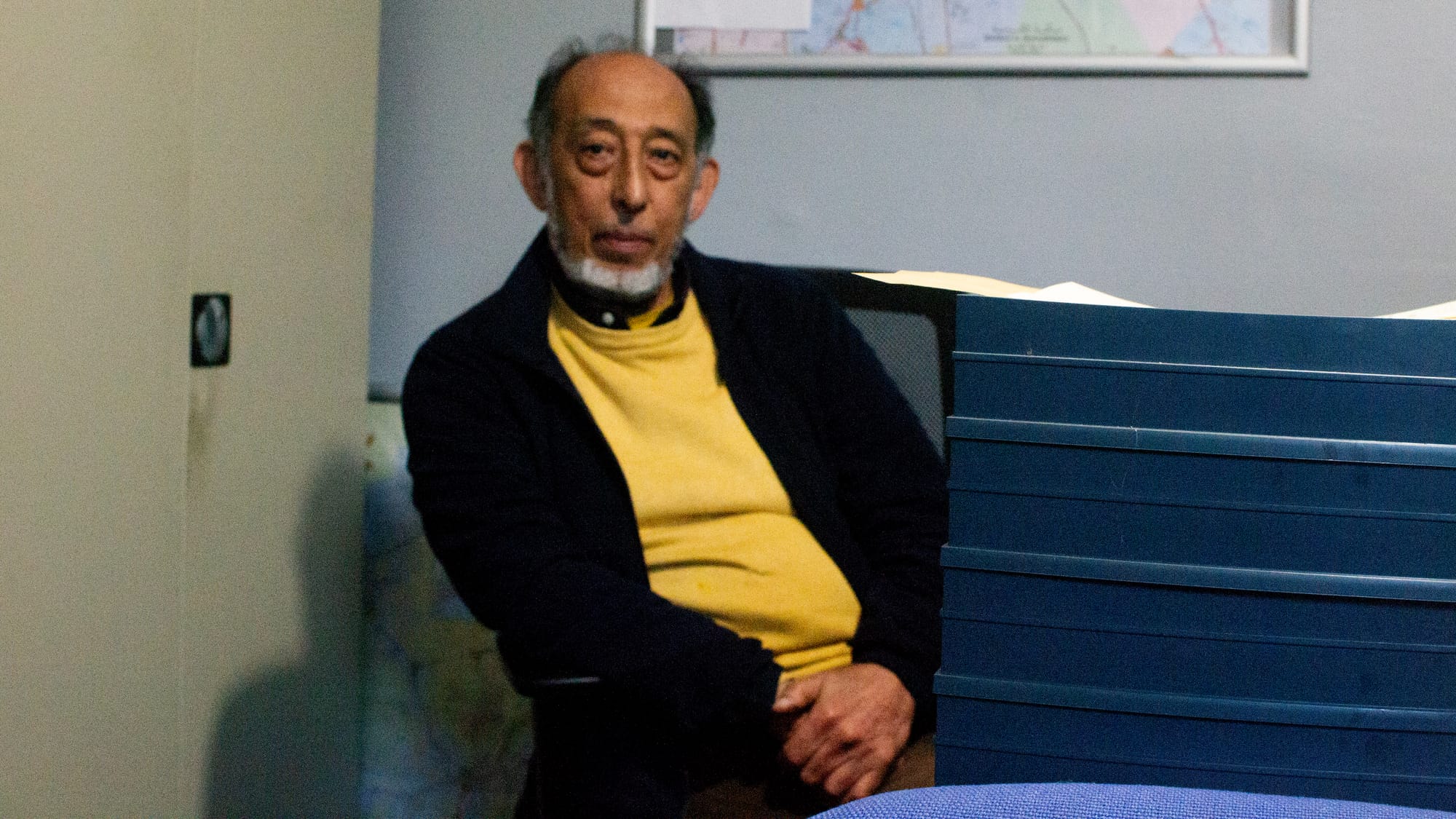
Ryklief, of the South Circular Road masjid, said he is worried that the parking problem will cause Muslims in the neighbourhood to become increasingly isolated and reviled.
Just recently, someone called him, he said, talking smack about Muslims and Islam. When Ryklief hung up, he phoned again. “He said, ‘I know where you live.’”
But Ryklief says he’s old and unafraid. “If somebody walks in with a gun and shoots me, I couldn’t care less, I’m 70 years old, what more do I have to look for? But I think of other people.”
There were young boys bustling in and out of the masjid on Friday. Women with young kids walked towards the women’s entrance.
As for the parking constraints, Ryklief said, he wants them resolved for their visitors, too, not for himself. “It doesn’t affect me at all. I take the bus,” he said.

In two cases, inspectors found that staff were using restraint to try to manage children’s behaviour, and one of those children was restrained 78 times.

Changes to make it possible were to be included in a new law, when first announced. But they were dropped.

About €7 million went into a pot for projects for the surrounding area, when the Oscar Traynor Woods deal was struck.

Dublin city councillors added a focus on social inclusion to the work of their housing committee in September 2024. But it hasn't really featured yet.