

What to do with the horses of Darndale?
Grazing in public parks means other uses are being pushed out, and adding momentum to calls for an equine centre and stable club to properly support horse culture in the area.
Grazing in public parks means other uses are being pushed out, and adding momentum to calls for an equine centre and stable club to properly support horse culture in the area.

Marie Staunton makes one of her several daily strolls around Darndale Park, her German shepherd Miya at her heels.
She stops to check on every horse she passes.
She knows many of the 30 or so horses scattered around by name. There’s Blue, Rosey, and Bambi, she says. That's just a few.
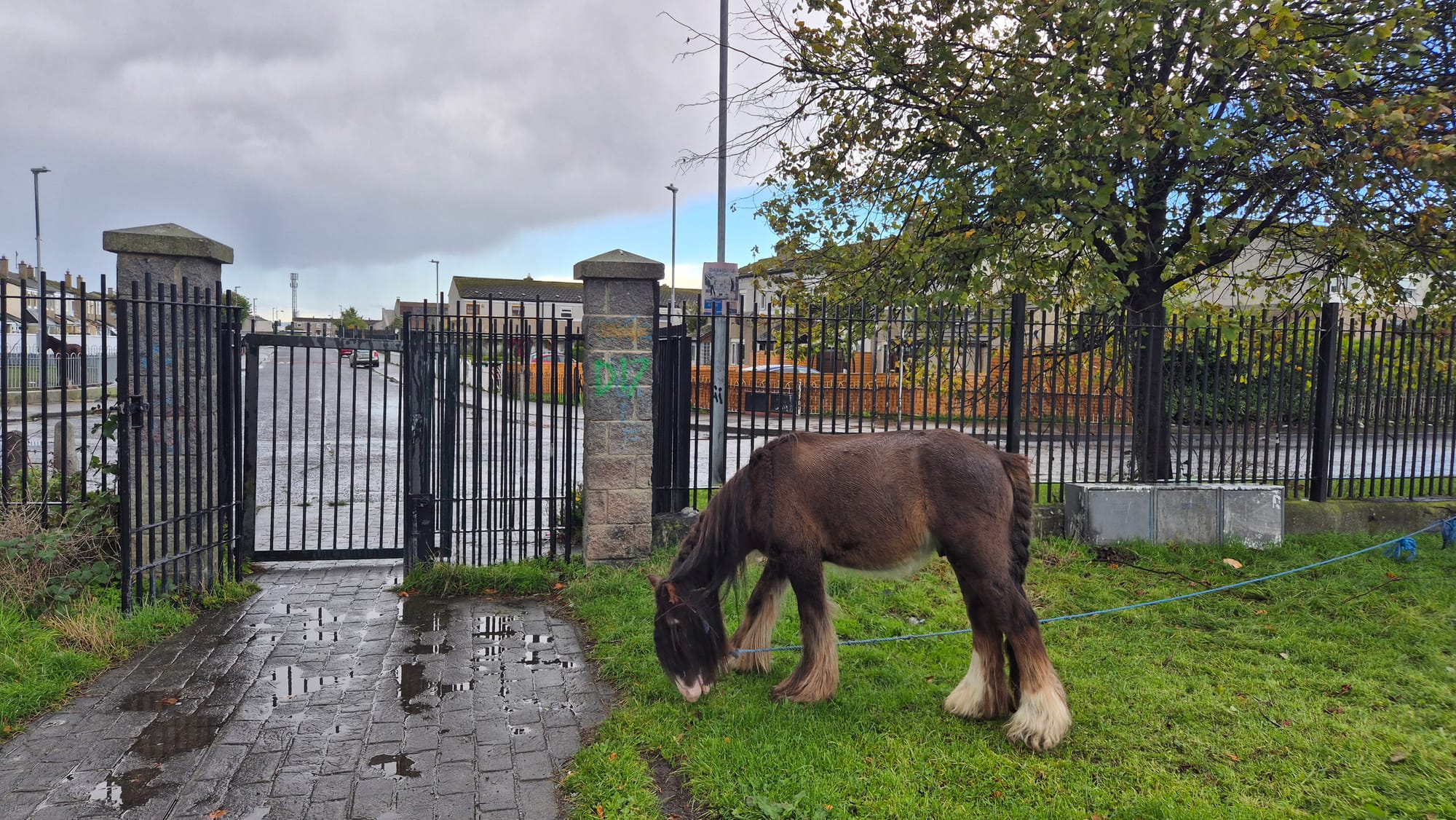
Each horse gently wanders closer to her as she approaches. Although most are tied with rope, with limited space to move around.
“They’re disappointed I have no treats for them,” she says. She embraces each as she chats to them, reassuring them that she would be back later. And she'll bring something, she says.
“It's only carrots, celery, apples, bread, and cornflakes,” she says. “I mix it all, I chop it all up, and it's all nice and fresh – and they love it.”
None of the horses belong to her, she says, but she keeps a watch over them all.
Many are well-cared for by their owners, she says.
But some of them sadly aren’t so well looked after, says Staunton, which largely comes down to a lack of understanding among the young owners – some of whom bought their horse for as little as €50, she says – not intentional neglect.
Still, for all the benefit that the horses bring to some people in Darndale, an area that decades back was farmland and has always had a culture and connection with horses, they are also inhibiting the wider community in some ways.
Darndale FC can no longer hold home games in Darndale Park because of interference from the horses, and their dung left all over the grass – also the added, worsening issue of open drug dealing, says independent Councillor John Lyons, who also serves as chairperson of the football club.
The club, now in its 50th year, was recently dealt another blow when their junior teams were left without a competitive league to play in, because of a reshuffle of how the leagues run.
Meanwhile, the should-be-weekly Darndale Parkrun has been cancelled since last December, for the same reasons.
Across the road from the park on Primrose Grove is a green, surrounded by houses. Two weeks ago, three horses grazed on the green. On Wednesday, there was triple that amount.
There were bales of hay left out for the horses, and the kissing gate into the green was fastened shut with a bike-lock.
The park’s challenges with anti-social behaviour made headlines this week, after the children’s playground was arsoned, destroying much of the equipment.
On Wednesday morning, through rain showers, the smell of burned polyethylene from the melted slide still hung in the air near the playground’s perimeter.
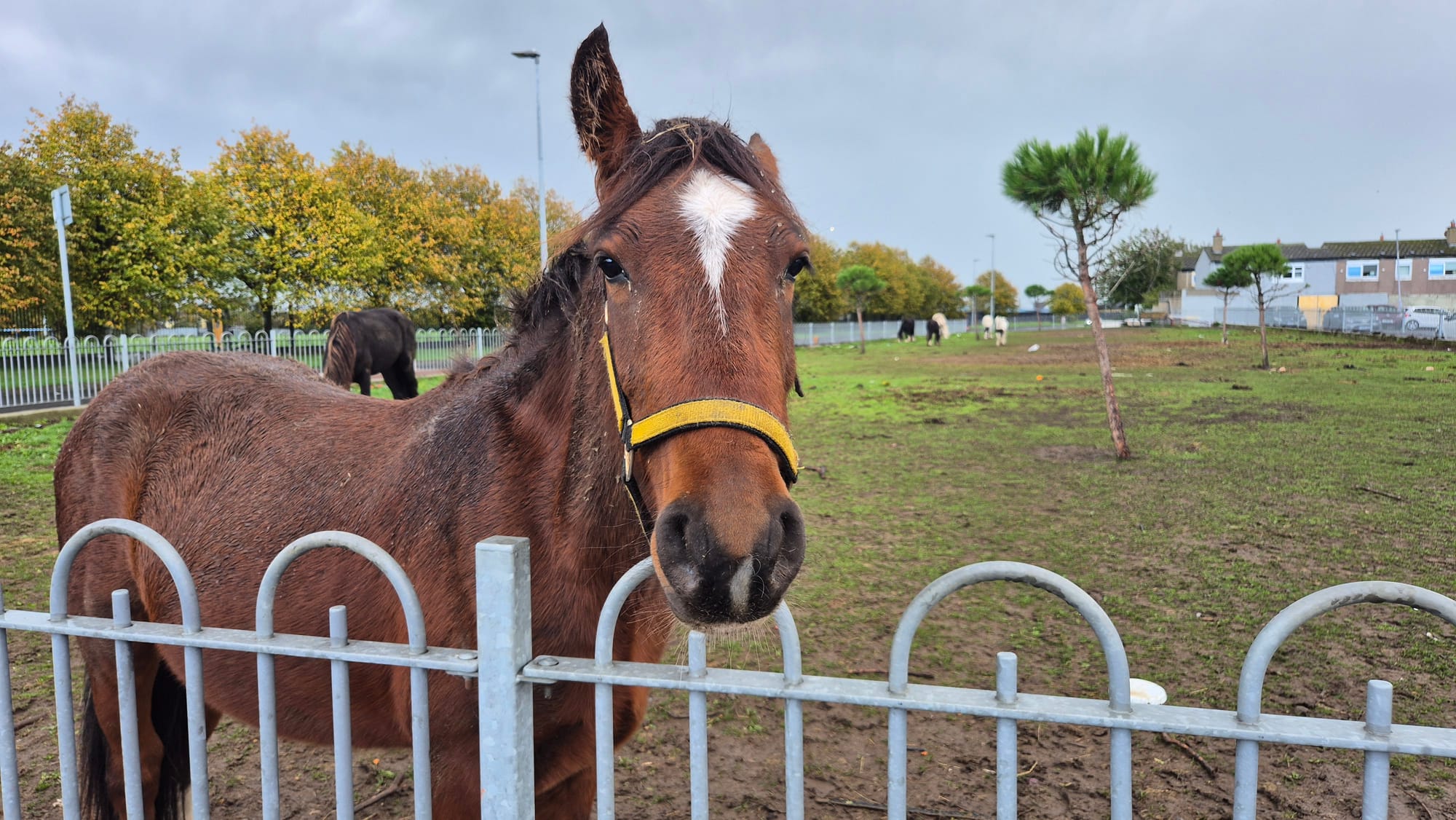
To the west of the park there is a large fenced enclosure, where several horses are kept. But it was never built for that, says Noel O’Reilly, a local.
It was installed by the council, intended to be a pocket forest, filled with trees, he says. There aren't any trees at the moment.
“The lads went down and said, ‘Well, they could do that, but they can't even give us anything for the bleeding horses,’” he says. “That sort of pissed the lads off.”
Horse lovers of Darndale need a dedicated space for their animals, says O’Reilly. And, he is trying to build momentum among the community and the council to build stables in the area.
“We're trying to sit down with the right people and just try get a temporary horse stable club up and going – like a little equine centre,” he said by phone on Tuesday.
There are parcels of land in the area that could fit the bill, O’Reilly, Staunton, and Lyons all say.
“There's bits of land on the side of Darndale Park,” O’Reilly says. “There's bits of land on the opposite side of the N32 there.”
It’s unclear whether a place for horses on those patches might clash with any existing council plans for them.
O’Reilly has seen the benefit that horses and “equine therapy” have had for men in the area down the years, he says.
“There's lads here that were drug-ridden for 10, 15, 20 years,” he says. “All of a sudden, they got their horses, and now, they're all out of crime.”
On Wednesday morning, local fisherman Gerry Jervis was in his regular place by the fishing pond in the park – where he goes to catch-and-release pike and carp and spends time trying to clean out the invasive weed that chokes the pond.
He knows a few young lads who keep horses in the park, who come from troubled backgrounds, he says. “A lot of them would prefer their horses than people.”
O’Reilly says that, at one stage, he was worried what road his own son would go down. “He came with a horse one day, and he hasn't looked back.”
His son now spends up to 60 percent of his income from his driving job on his horse, says O'Reilly. “His time is swallowed up by horses, in a good way.”
Still, O’Reilly says he knows that people in the community are also losing out on their own use of the park – so, he wants to see the horses, and the benefit they bring to their owners, given a new home.
Getting a stable or equine centre for the area isn't going to be easy, says O’Reilly. It needs community effort – with some help from the council, he says.
He wants to have the opportunity to trial something, for even a few years. If it doesn’t work, at least he will know he tried, he says.
They could start with large metal containers retrofitted to be acceptable for keeping horses, he says.
Local residents are interested, he says. “A lot of people contacted me and said, ‘Oh, listen, if you do get them up and going, I'm good at welding, I'm good at woodwork, and I'm good at this, I'm good at that.’”
He knows that just building stables and walking away will leave them susceptible to being taken over by criminals, and they’ll have to work hard to avoid that happening, he says.
It could be a community project – bringing in men's and women’s sheds to work on it, and involving the community clean-up crew, and other groups.
It would be successful with the right people behind it, he says. “And lads need to realise, ‘Youse don't run this, youse just rent the stable out.’
They're going to have to pay a little bit of a fee for the upkeep of the yard, and wages need to be paid to a couple of staff at the end of the week, he says.
He envisages a mix of voluntary workers and some paid staff to run it, he says.
“You know, to have it operated correctly. Animals have to be looked after right, and as well, you can have the likes of vets, and trainee vets coming out regularly,” he says.
Martina Kenny, co-founder of My Lovely Horse Animal Rescue, says that the name of her organisation is not very popular with some horse owners in Darndale.
Her team have been responsible for removing uncared-for horses from the area in the past, she says.
But, the absolute priority of her organisation, she says, is to make sure all horses, all animals, are able to live happily.
“There's some really nice guys there that love the horses and it really does help them in their day-to-day lives,” she says. “And you know I'm not going to take that away from somebody.”
But then there's others that just leave a horse tied up for days on end. “With no water, no shelter, no nothing, and that's wrong on a million levels.”
Kenny thinks something along the lines of what O’Reilly, Staunton and others are calling for could really work – adding many of the same caveats as O’Reilly.
Even if not a formal stable, she says, even shelter for the horses would be good.
Staunton made the same point on Wednesday morning, on her rounds.
“The heat we had was awfully hard on them,” she says. “Lads wouldn’t be giving them enough water. Some think that all a horse needs is plenty of grass, but there’s a lot more.”
And in the winter, some horses are left without a jacket to keep them warm and no shelter to keep them dry, she says.
Kenny says that My Lovely Horse would be delighted to help in a stable and horse club project in Darndale. It's the kind of project they've been involved in before, she says.
They are part of a community horse project in Kilkenny, working with people from the Travelling community, she says, and it's been great.
Everyone involved is open to dialogue and all learning about how to best care for horses, she says.
They talk about how to manage grass, how many horses are best for what size area, how to plan for hay and grass the following year, she says.
My Lovely Horse stay hands-on, she says. “We don’t step away from it.”
The key is to start getting the right people talking to each other, says Kenny – echoing O'Reilly.
Kenny says the local horse-enthusiasts also have to step up and reject anyone who is neglecting their animals and call it out. And the council will have to say, if you aren’t keeping your horse properly, it will be taken, she says.
However, says Staunton, historically if horses from the area are taken by officials, they will be replaced by the owners almost immediately.
In response to a motion raised by Lyons at last week's meeting of the council’s North Central Area Committee, area manager Derek Farrell said the council is trying to find solutions.
“It is very important that we do take some action with the antisocial, with the horses,” he said. “I mean, there are a lot of horses in Darndale at the moment.”
“Some are owned by criminality, others are not,” he said.
“Unfortunately, they're taking up the park. They're taking up lots of the area,” he said. “And we are trying to work on a way around that.”
Farrell said the council has set up a subgroup to try to deal with the spiralling situation.
The council did not respond to queries sent on Monday, asking for more information on this subgroup, what plans it has to address the horse situation, or if it would help to fund an equine facility in the area.
Meanwhile, Staunton says she will continue to watch over the horses of Darndale for as long as she can. But "this is an area that needs something", she says. "These horses need something."
Funded by the Local Democracy Reporting Scheme.

Like, what'll be the route to dig up the footpath and lay down a wire?

The chapel on the ground floor is too small for a theatre “but it's the kind of place where you could have recitals, a piano player or string quartet”, says Diego Fasciati, the executive director.

Dublin City Council's planning committee backed a motion on Monday to call on the Minister for Housing to broaden the legal definition to include long-term vacancy.

Some experts worry about the impact of the new rules, especially on more vulnerable households, as they await guidance on the details of how they will be implemented.