

Dublin City Council, again, bans poster to spare US president's feelings
Even a version which made no direct reference to Trump and removed his image, and simply read: “No welcome for warmongers” was turned down.
There's a plan to reduce motor vehicle traffic along the route, and install kerb-segregated cycle lanes along most of it – but moving very, very slowly.

About 2pm last Wednesday afternoon, Aitor Arribas was walking his bike along towards town along the footpath next to Lower Rathmines Road.
He lives in the Docklands, but had been in Rathmines to pick up something from a shop, and was headed back into town, Arribas said.
The route north past Lidl and the other shops, and up to this spot nearish the Spar and the canal, didn't feel safe, though, he said. "That's why I was actually walking."
Indeed, a look at the map on collisiontracker.ie, which includes years of reports from cyclists, as well as – recently added – years of data from the Road Safety Authority (RSA), shows a dense snake of yellow, orange, and black dots along this corridor from Dame Street down South Great Georges Street all the way down Rathmines Road.
Each dot is a report of a hazard, near miss, collision, or fatality, from 2016 to present. Junctions that were trouble spots a decade ago continue to attract reports of dangers today.
Like the intersection of Lower Rathmines Road and Richmond Hill and Military Road. "This is definitely an awful junction,” Colm Ryder of the Dublin Cycling Campaign said back in 2015.
"Repeated near misses at evening rush hour with car drivers turning right onto Richmond Hill," said a report to collisiontracker.ie in 2024. "Almost hit by a driver turning right from Rathmines Road," said another report, from April of 2026.
Or the intersection between Lower Rathmines Road and Grove Road, at south side of the canal. At the time, Brian Reddy said he often cycled near Portobello Bridge and it could be a scary spot for cyclists.
And still today, it can be scary. "Car turned left into me at Rathmines Road while I was travelling straight on towards Grove Road on the bike lane," says a report from April of 2026.
There have been some improvements for cyclists over the years along corridor, some segments of cycle lane protected by plastic bollards, for example.
But the big change that's in the works is a massive revamp of the whole corridor, as part of the long-running, ongoing, massive BusConnects project meant to improve bus service in the city.
The Rathfarnham/Templeogue to City Centre Core Bus Corridor, which would go right up through Rathmines and into town, would reduce private car traffic through this segment, and add cycle lanes along most of it, segregated from vehicle lanes by kerbs.
"The plans are good, generally speaking," said Ciarán Ferrie, a local resident, who has reported near-misses along the route to the collisiontracker.ie. "My main thing about the route is it can't come soon enough."
However, although the National Transport Authority (NTA) got planning permission for the project in December 2024, some residents affected by it have gone to court to challenge it.
There are four or five cases, all to do with details of the project in Terenure and Rathgar, says Brendan Heneghan, one of the plaintiffs. He said he expects them to all be heard together later this year.
The density of reports to collisiontracker.ie. By Brian Rogers. Note the line of tall towers down the Rathmines to city centre corridor.
As part of BusConnects, the NTA is planning 12 core bus corridors, radiating out from the city centre like spokes on a bicycle wheel.
They're all meant to redesign the roads to clear the way for buses to run faster, more reliably, and more punctually – and while they are at it, to add better cycle lanes and footpaths.
Combined, this is meant to make it easier for people to get where they need to go in Dublin while spending less time sitting in congested traffic, and producing fewer carbon emissions.
This particular spoke would actually start in two places, Rathfarnham and Templeogue, and these two branches would converge in Terenure and then run together up through Rathgar and Rathmines onward to Dame Street.
From the junction of Rathgar Road and Lower Rathmines Road, down by Slatterys pub and Kwality Foods, there will be two segregated cycle lanes: inbound on the left side, outbound on the right.
The drawings of the designs show the cycle paths going behind loading bays there, on the footpath side of them, so cyclists and delivery vans pulling out into traffic wouldn't clash.
The kerb-segregated cycle lanes would run right up through Rathmines, going behind bus stops. In some spots they go behind loading bays, in others, where the footpath is narrower, in front.
This would be a big change for cyclists.
At the moment, the cycle lanes, where they exist, are painted onto the road, occasionally protected by bollards, usually not.
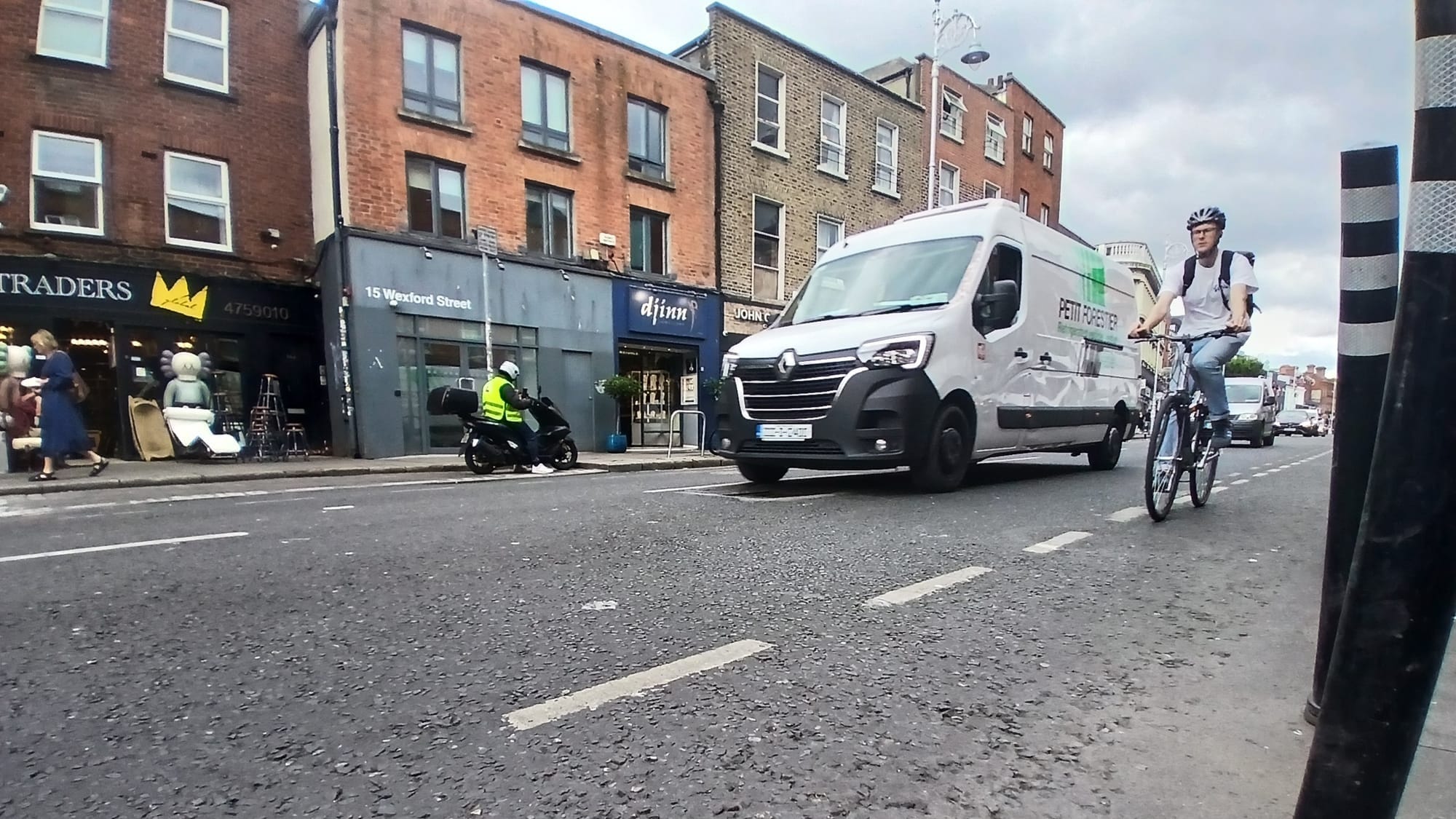
And where they exist, they always go between loading bays/bus stops and motor vehicle lanes, leaving cyclists jockeying with buses and vans pulling in and out.
These types of changes to cycle lanes continue all the way up this corridor to Dame Street.
The preliminary design report for the project, dated March 2023, says that between Rathfarnham and the city centre, at that time, going inbound, there was no segregated cycle lane, and outbound 5 percent of the route had segregated cycle lane.
The proposed changes would put in segregated cycle lanes for 90 percent of the outbound route and 85 percent of the inbound route, it says.
Running cycle lanes behind bus stops means pedestrians on the footpath who want to take the bus must cross the cycle lane.
Several submissions said this endangers pedestrians, which the inspector for An Bord Pleanála, as it was then, addressed in their report on the project during the planning process.
"On approach to the bus stop island the cycle track is intentionally narrowed, with yellow bar markings also used to promote a low-speed single file cycling arrangement on approach to the bus stop," the inspector wrote.
"To address the potential pedestrian/cyclist conflict, a pedestrian priority crossing point is provided for pedestrians accessing the bus stop island area," they wrote.
In its order granting planning permission for the scheme, An Bord Pleanála paid special attention to these island bus stops in particular.
"Prior to commencement of development, the developer shall agree in writing with the planning authority details of the precise design and layout of pedestrian crossing facilities over cycle tracks at island bus stops on a case-by-case basis which shall be informed by the Cycle Design Manual," the order says.
Overall, all these new cycle lanes would probably help make cycling along the straight sections of the route safer.
But many of the incidents recorded on collisiontracker.ie, both reports to the site, and RSA data, are clustered at intersections.
In the experience of Ferrie, the sometimes cyclist, this is "absolutely" true.
Alongside the new kerb-segregated cycle lanes, the project would also introduce changes for people driving private cars through this corridor.
Perhaps the main impact of these would be that a person driving a private car could no longer just buzz along this route from end to end.
At the moment, this is possible along most of this route – except for a short stretch between Harrington Street and Charlotte Way, where private car traffic is inbound only.
Under the proposed changes, there'd be a "bus gate" on Lower Rathmines Road, between Richmond Hill and Lissenfield. So, just near the big sports pitch at St Mary's College.
This "will restrict general traffic movements during the hours of operation of the Bus Gate (06:00 – 20:00, 7 days a week)", the preliminary design report says.
Private vehicle through traffic would not be allowed to pass this point during those hours. Although "public service vehicles" (buses and taxis) would be allowed through, the drawings say.
Also, going inbound along Lower Rathmines Road, at Grove Road/the canal, only buses and taxis would be allowed to continue on across the bridge over the canal towards town along Richmond Street.
Private vehicle traffic would be required to turn left onto Grove Road along the south side of the canal, the planning documents say.
From the canal to Harrington Street, there'd be bus lanes going both inbound and outbound, and cycle lanes going inbound and outbound – but just one lane for private vehicle traffic, going outbound.
Then the direction of the private vehicle lane switches to inbound until Grantham Street. Then it switches to outbound.
Then, from Cuffe Street/Kevin Street to Dame Street, two-way private vehicle traffic would again be allowed.
If you are reading this, and you are confused, and it makes you think you would not want to use this route to get into or out of town, only for local access to homes and shops and things, that is the intention of the plan.
"My initial thought is a lot like uuugh," says Sara Black, when told about these plans on the footpath across from Aldi in Rathmines on Wednesday.
The changes would presumably reduce the volume of traffic along the corridor, something Ferrie, the local resident, says would help make the whole thing, including the intersections, a bit safer.
When traffic is heavier, and drivers are waiting for long periods at lights, and frustrated, they are more likely to zoom through fast – and even after the light turns red, Ferrie says.
Less congestion along the route should mean fewer frustrated drivers, and a bit less zooming through intersections and breaking red lights, he said.
After her initial reaction, Black, who was unlocking her bike from the bike stand in Rathmines Wednesday on the footpath across from Aldi, thought about it again, she said.
She drives the route a lot now, and had been thinking about the hassle the traffic changes would create for her as a driver.
But she used to cycle it all the time, before she had a kid, she says, gesturing to the child seat on her bicycle. Then she felt it was just too dangerous to cycle it together, and started driving it more.
Maybe after all the changes, she'd feel safe enough to switch back to cycling more, even with her little one, she says.
However, the changes will have to wait a bit longer.

There are four or five cases in court taking issue with how An Bord Pleanála handled the process of reviewing and approving the NTA's planning application for this project, says Heneghan, a plaintiff in one of the cases.
None of them have to do with this stretch up Lower Rathmines Road and the other roads to Dame Street, Heneghan says.
For his own part, his is to do with a change in his area, a bit further out, on Rathgar Road, that would make it harder to access his home from the route, he says.
As a result of one turn no longer being allowed, a one-minute trip to the supermarket will turn into a 20-minute detour and a trickier right turn.
"And I don't want to be doing that for the rest of my life," Heneghan says. It's a minor issue, easily solved, which he raised with the NTA to no avail, he says.
So, for lack of any other route to make himself heard, and get this detail changed, he's gone to court, Heneghan says, challenging the procedure by which the decision was made.
If he wins, there might be an opportunity to get his turn issue addressed.
The government, under pressure for not delivering housing and transport infrastructure fast enough, has recently been on the attack against judicial reviews, bringing in new restrictions meant to reduce their number.
And suggesting they'd like to go even further. In April, Fianna Fáil TD Jack Chambers, Minister for Public Expenditure, Infrastructure and some other things, said in the Dáil, "I am against all judicial reviews."
So how would Heneghan respond to critiques of judicial reviews in general, and to people who might feel he is holding up this transport infrastructure project in particular?
He says he tried to resolve the issue without going to court, and would not even have a case if An Bord Pleanála had conducted the process correctly.
With his court case, he says he's been prompt with meeting deadlines for filings – while the state has been much slower. So who is really holding up the project? he asks.
Barrister Cathal Malone has been outspoken in defence of people's right to challenge government decisions in court.
"If something is being done by unelected bureaucrats behind closed doors, there's got to be a way to challenge that," Malone said Wednesday. "Surely, it's always in the public interest that the government follow the law."
Ferrie, the local resident, says he thinks the government's efforts to keep people from being able to take judicial reviews are "tackling the problem from the wrong end".
"I think a lot of them have been the result of a lack of meaningful engagement at the beginning, so judicial review is the only route left open," Ferrie said.
Of course, on this project, the NTA held multiple public consulations on the project, over several years, received thousands of submissions from individuals and groups on their views, issues, and suggestions, considered these, and responded.
Still, though, some people obviously did not feel heard enough, or did not get the changes that they wanted. Now several people have taken legal action, and the project is before the courts.
However, since none of these cases relate to the stretch from Rathmines to Dame Street, "it seems unfair that the entire project is being held up because of issues elsewhere", say Ferrie.
The NTA has not responded to queries sent Friday about the judicial reviews, and whether there's any prospect of resolving them anytime soon.
CORRECTION: This article was updated at 08.33 on 31 July 2026 to reflect that Ferrie was no longer with the Rathmines Initiative at the time this article was published. Apologies for the error.

Even a version which made no direct reference to Trump and removed his image, and simply read: “No welcome for warmongers” was turned down.

"As you can imagine, you've got 20 parking spaces, and we come along and say we're going to take out two of them or something like that to give spaces for people on bikes, it doesn't go down particularly well."

Louth County Council passed a motion calling for other local authorities – including Dublin City Council – to join it in pressuring the government to change national planning regulations.

“I don’t think we do have a policy on displacement,” says Labour Councillor Darragh Moriarty. “But there probably should be something in light of the private rental market being so volatile and so precarious.”