Lauren Fernandes noticed menus and flyers all over with the same sterile look, and thought: what if she could help out small businesses which can't afford creative work, usually?
It would use extra heat from the Poolbeg rubbish incinerator to warm water and send it through pipes underground, into buildings in the city, to keep homes and offices cosy without burning additional fossil fuels.
Projected cost of Dublin District Heating Project rises to more than €130 million
It would use extra heat from the Poolbeg rubbish incinerator to warm water and send it through pipes underground, into buildings in the city, to keep homes and offices cosy without burning additional fossil fuels.
The projected cost of the council's planned Dublin District Heating Project has risen to more than €130 million, according to a new report from the Local Government Audit Service.
That's a 69 percent increase over what Dublin City Council said about the project in 2022, when it was projecting the total cost at €76.9 million in its capital programme – its multi-annual budget for big one-off projects like this.
The project would use extra heat from the Poolbeg rubbish incinerator to warm water and send it through pipes underground, into buildings in the city, to keep homes and offices cosy without burning additional fossil fuels.
It's one of several district heating projects planned in Ireland, as the government pushes to reduce the amount of fossil fuels used to heat buildings in the country, to help blunt the impacts of climate change.
"This project will be the largest district heating network in the country and contribute significantly to the reduction of CO2," according to the council's most recent capital programme.
Even as this flagship district heating project's budget keeps rising, its timeline keeps stretching out too.
In 2022, the council said the project "has been beset by delays. We now expect to go to the market in early 2023 with construction starting in early 2024. The full project will be rolled out over a 4-year period 2023 to 2026."
Four years later, this new audit report – which was on the agenda for Monday's monthly meeting of the council – says that the "interim phase" of the project "is now forecast to be operational by Q4 2028, with an updated budget of €10.7m".
And "The overall Phase 2 project has an estimated total cost of circa €120m and a revised delivery timeline of 2032", it says.
The documents suggest that, as the council has previously said, the project would not initially pipe heat into the homes in the residential neighbourhood of Ringsend, nearest the incinerator on the Poolbeg Peninsula.
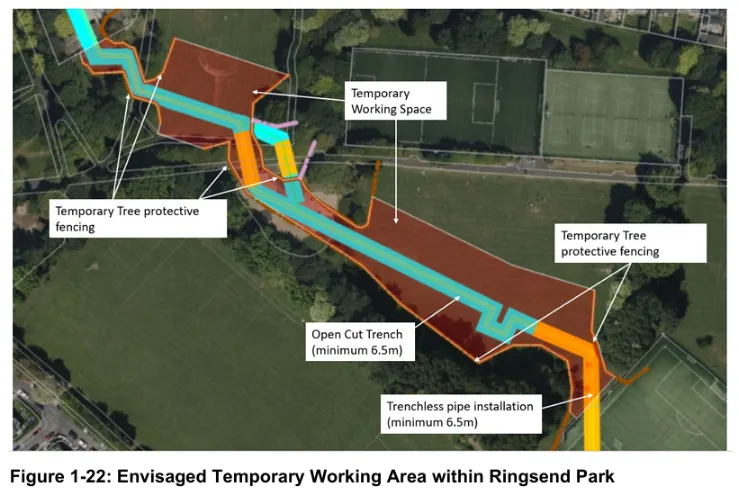
Instead, the works would connect to the new Glass Bottle development, dig temporary trenches through Ringsend Park to lay insulated pipes to carry the heat to the high-end apartment and office buildings around Grand Canal Dock, where some tech companies are clustered, and then cross the Liffey to the shiny high-rises of Spencer Dock.
That plan to bypass Ringsend and Irishtown in the initial phases might be in flux though. After initial dismay among some residents there, council officials said in August that they'd look at connecting community facilities in those areas early on.
The "interim" phase
The Poolbeg incinerator burns rubbish, and that heat boils water, producing steam that runs a thermal turbine generator to produce electricity that's exported to the grid. That's happening already.
Now, even as it continues to generate electricity, the council wants to also use some of the heat the incinerator produces to warm buildings. The first phase of the project is what it's working on now.
That would involve installing the infrastructure at the incinerator to capture the heat and transfer it to an underground pipeline network, through the Poolbeg West Strategic Development Zone (SDZ), onwards to the Grand Canal Dock SDZ, and across the river to the North Lotts SDZ.
There's a room already in the incinerator, awaiting the delivery of the equipment needed to hook it up to a district heating system, according to a report describing the project that's part of the planning application.
"All of the individual items of plant and equipment will be transported to the site by Heavy Goods Vehicles (HGVs) and off loaded by crane," it says. "It may be necessary to temporarily remove sections of cladding from the DWtE [Dublin Waste to Energy] facility building to facilitate installation."
From the incinerator, the project will involve laying underground pipes to the Poolbeg SDZ, where the Glass Bottle housing development is now under construction, and onwards through Ringsend Park.
The works will cross 420 metres of the park, along a pathway about 30 metres wide, the report says.
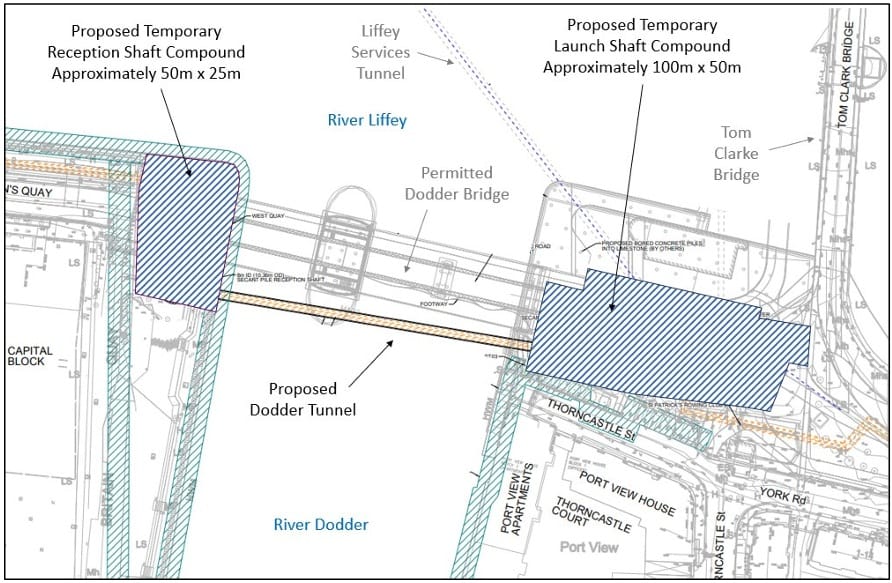
The pipes will then tunnel under the River Dodder to the south docklands. From there, they'll pass through the existing Liffey Services Tunnel to the north docklands.
"Buildings within these zones that are district heating enabled will be able to connect to the system," says a council report on the project. "Customers will be able to connect to the system during this Initial Phase."
It's unclear so far how exactly the heat from the system will be priced, and so whether it will be more or less expensive than what people in those buildings are paying now.
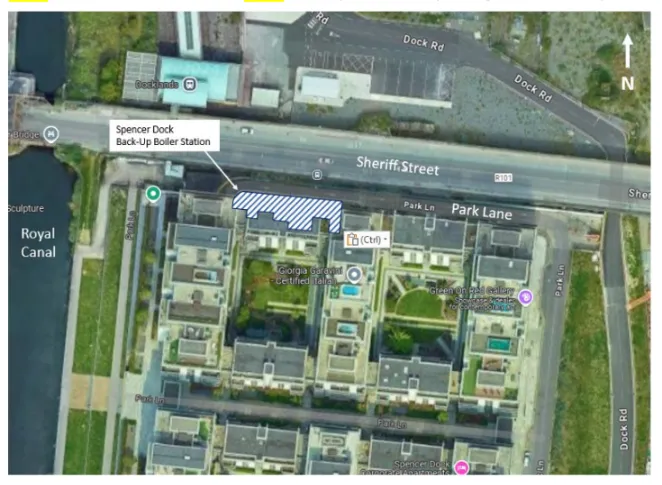
There's already a boiler room at Spencer Dock, on Park Lane, next to Sheriff Street. It was designed to be capable of supplying backup heat to the Dublin District Heating Project – so if the incinerator needs to be turned off for maintenance or whatever, the heat won't go off for the district heating system's customers.
At the moment, there are six gas-fired boilers in it. As part of the initial phase of the project, those would be removed and replaced by three bigger ones, the description of the project says.
This is all part of the initial phase that the council plans to build in 2027 and 2028.
A council planner's report on the proposal ran through a bevy of submissions from various council departments looking after the roads, surface water, warning of potential conflicts between this project and other ones already in the works.
The repeated message was: the Dublin District Heating Project team needs to coordinate with all these other projects to avoid the same road being dug up twice in a row, if possible, and a tunnel running into a gas line, and that kind of thing.
Overall, the planner's report said "the Planning Department has no objections to the scheme progressing to application stage". Which it did, in early September.
For the future, the project description talks about the construction of a new energy centre in Poolbeg.
"The Energy Centre will provide greater resilience to the overall system and allow the connection of more customers to the district heating network," it says. "The Energy Centre will be subject to a separate planning application for development consent."
A timeline in that document suggests it'll be built between Q1 2030 and Q1 2032.
The project is to be funded €50 million in grants from the Department of Climate, Energy and Environment, plus €50 million to €60 million in loans, plus €10 million to €20 million in "miscellaneous income", according to the audit report presented at Monday's council meeting.
Once the system is up and running and heating homes, and the new energy centre is built, "it will be possible to expand the district heating network further to include more customers and also additional sources of heat", the project description report says.
"Presently, there are no specific plans for the development of the district heating network beyond the infrastructure outlined above," it says. "It is envisaged that as the number of connected district heating customers increases and demand for new connections grows, specific requirements will become clear."
At a council committee meeting in September 2025, Karen Kennedy, a senior council engineer, said that in future, the idea is to expand the network further west towards the city centre, and south toward the area anchored by St Vincent’s University Hospital – and to connect new heat sources, beyond just the incinerator.
A local GAA club works with children with additional needs, said one councillor. “They have children with needs that need to be met and the closer they can be dropped off to the pitch, the better.”
Grazing in public parks means other uses are being pushed out, and adding momentum to calls for an equine centre and stable club to properly support horse culture in the area.