

What to do with the horses of Darndale?
Grazing in public parks means other uses are being pushed out, and adding momentum to calls for an equine centre and stable club to properly support horse culture in the area.
“It’s literally George Floyd on the streets of Dublin. I can’t believe that scene and that guy with his knee on his neck.”

It reminded him of George Floyd, pinned to the ground and dying under the knee of a cop on the streets of Minneapolis, said Jude Hughes, a Black Irish community activist.
“It’s literally George Floyd on the streets of Dublin. I can’t believe that scene and that guy with his knee on his neck,” he said, in a Zoom meeting on Monday night.
The emergency meeting was organised by the Africa Centre for Black people across the country to come together and process their feelings about what had happened on Friday – and strategise on how to respond.
More than 100 people had joined.
On Friday, Yves Sakila was pinned to the ground on Henry Street by a few men, a video circulated on social media showed.
At one point, one of them, an older man in a black suit, throws himself onto his neck and pushes down with his right knee.
A few seconds later, he removes his knee, but keeps pressing on his neck with his hands. Someone else is pinning his head to the ground. Other men press on his body.
You can hear Sakila grunting and moaning amidst the chatter of the passersby.
By the end of it, he seemed unconscious. He was later pronounced dead.
Gardaí has said there will be a post-mortem to officially determine the cause of his death. That would aid its criminal probe, too, they have said.
Sakila is accused of stealing from the nearby Arnotts store. If convicted, he could have faced jail time – but there is no death penalty in Ireland.
It later emerged that he was born in the Democratic Republic of the Congo (DRC).
At the meeting on Monday night, attendees said how hurtful it was that he’d died like that.
It has come at an already distressing time, not long after former Fianna Fáil Taoiseach Bertie Ahern singled out Congolese people, but also Africans in general – during a bye-election canvas – as the group of immigrants who worry him the most. His comments were captured on video.
He later walked back his remarks, but also said, “It’s a sad day if you’re jumped on for talking about immigration,” according to the Irish Independent.
Of course, the guys pressing on Sakila’s neck didn't know he was born in the DRC.
“Your average person on the street, who is not African, does not know the difference between a Ghanaian and a Kenyan. All they see is a Black person,” said Yemi Adenuga, a Fine Gael councilor at Meath County Council – and Ireland’s first Black woman elected to public office.
Still, it hurts so much, said Kembetia Bissa of Congolese Community in Ireland (CCI).
But what had happened to “our brother”, he said, offers an opportunity for togetherness and solidarity amongst not just Black people who were and weren’t born here, but all immigrants, to push back against hate.
“Fight this together,” said Bissa.
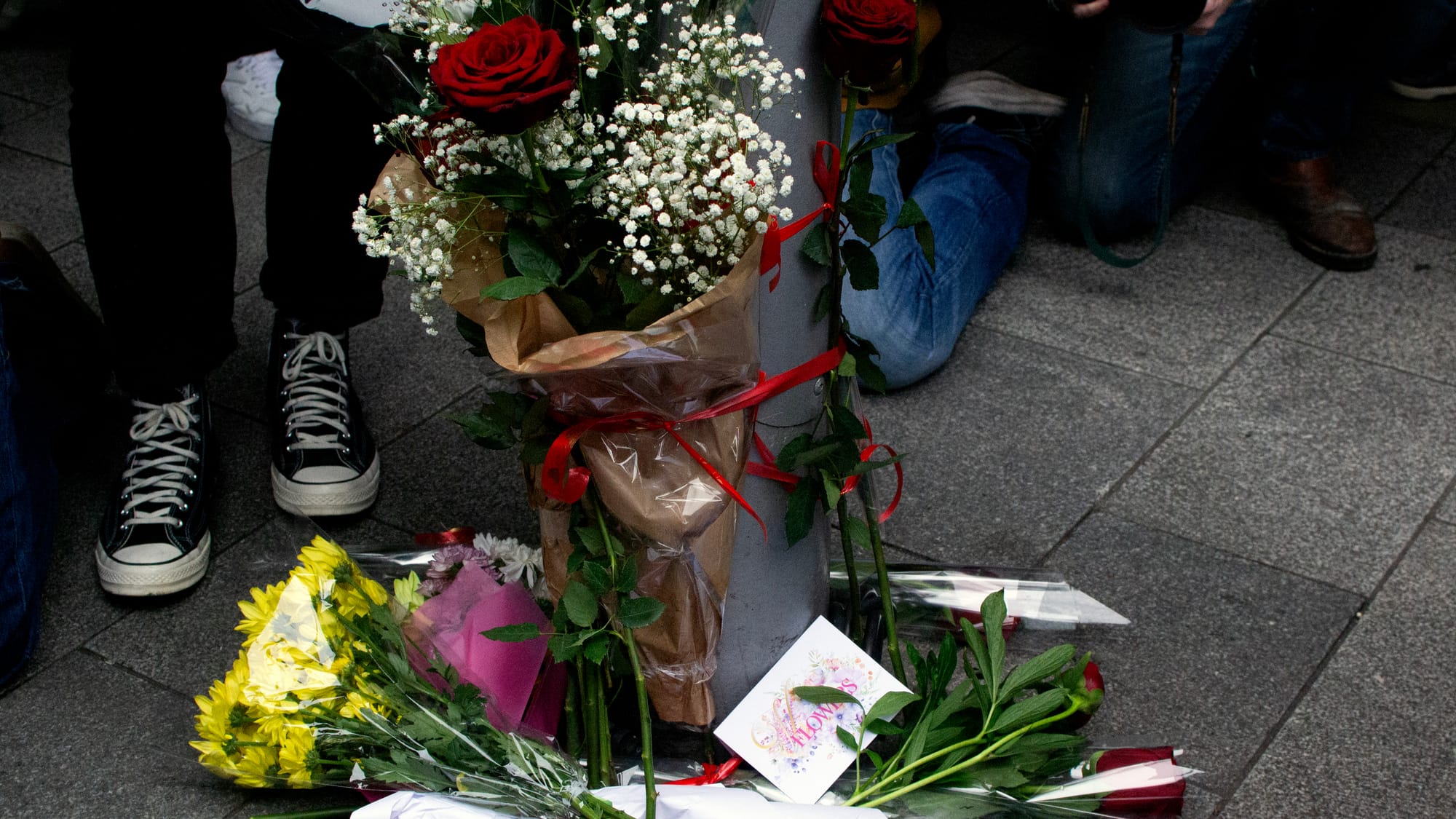
At the meeting on Monday night, people agreed to lay flowers on the spot where Sakila died on Tuesday noon, and gather outside Leinster House on Thursday. To hold a press conference and talk to TDs.
On Tuesday at noon, Arnotts had shuttered its Henry Street entrance. “As a mark of respect these doors will remain closed this afternoon,” read a paper attached to the door.
Its entrance on Abbey Street was open.
A tall Black guy was chatting to a cop in leather trousers just before the vigil began, saying how he’s never seen something so upsetting in his 30 years here.
The officer bobbed his head, gazed down and pressed his lips into a line.
Dublin Central by-election candidates – the Labour Party’s Ruth O’Dea and People Before Profit’s Eoghan Ó Ceannabháin – turned up. Former People Before Profit TD Bríd Smith hugged a bouquet of flowers.
Reporters clustered around the spot where people laid flowers. One of them kept asking what Sakila was like, and was told that he was “nice”.
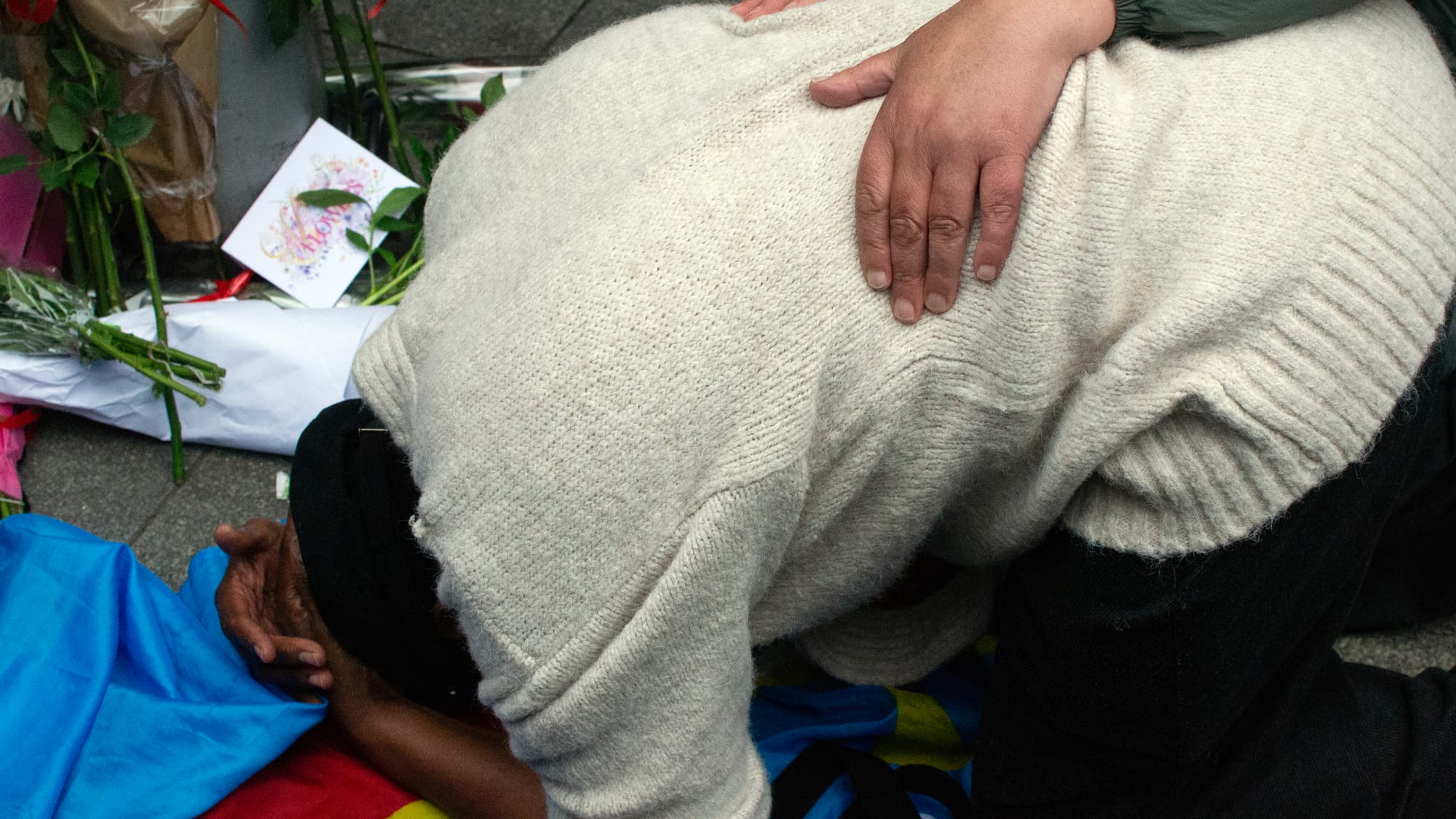
At one point, a woman, his stepmother, – said Africa Centre’s Lassane Ouedraogo later – crumbled at the site of his death, on the flag of the DRC, crying with anguish.
She spoke mostly in French. But she said “Why? Why?” in English, sobbing.
Shane O’Curry, director of the Irish Network Against Racism (INAR), who’d come to the vigil, said he was troubled by reports that the guards had still put handcuffs on Sakila, even though it seems he was unconscious by the time they arrived.
Meanwhile, anti-immigrant groups are already demonising Sakila, underlining that he had been homeless and that he had stolen before.
In his book, Copaganda: How Police and the Media Manipulate Our News, American civil rights lawyer Alec Karakatsanis writes that petty crime like retail theft is commonly weaponised to justify violence towards ordinary people, “and promote punishment as a solution”.
Instead of focusing on better investment to address “poverty, lack of affordable housing and healthcare”, he wrote.
Sakila’s social media suggests he'd been repairing laptops and phones as a job at one point.
At the meeting on Monday night, Bissa of CCI said he’s been troubled by the racist rhetoric amplified and growing in recent years.
And the comment by Ahern, the former Taoiseach, was a reflection of how normalised that kind of talk has become. He worries about that a lot, he said.
Nothing can bring back Sakila, Bissa said, and he and his community will fight for justice.
In a press release, the Irish Council for Civil Liberties (ICCL) called for “swift, thorough and transparent investigations by An Garda Síochána and Fiosrú to establish what happened, ensure justice is done for Mr Sakila and maintain the confidence of ethnic minority communities”.
More than anything, though, Sakila’s death should give rise to a greater sense of solidarity and organising among immigrants to push back against hate, said Bissa, of CCI.
“This time we want to organise as one voice, one community,” he said.
Adenuga, the Fine Gael councillor, who hosted the Zoom meeting on Monday evening, said it is time to build a lasting support network and be there for one another, rather than just pulling together at times of unbearable loss.
“I cannot tell you how much I cried watching that video,” she said.

Grazing in public parks means other uses are being pushed out, and adding momentum to calls for an equine centre and stable club to properly support horse culture in the area.

Like, what'll be the route to dig up the footpath and lay down a wire?

The chapel on the ground floor is too small for a theatre “but it's the kind of place where you could have recitals, a piano player or string quartet”, says Diego Fasciati, the executive director.

Dublin City Council's planning committee backed a motion on Monday to call on the Minister for Housing to broaden the legal definition to include long-term vacancy.