

“It’s giving colonialism”: Ireland still owes rent to dukes and earls
Although, even though the OPW lists these rents as payable, some of the named beneficiaries say they haven't been getting them.
It has been working, for more than a decade, on plans for more permanent flood defences. But those aren’t built yet.

Since it still hasn’t been able to strengthen the permanent flood defences in Clontarf, Dublin City Council is planning additional temporary defences before winter.
Council officials have for more than a decade been working on plans to strengthen the flood defences along the promenade.
As the years pass, the sea level rises, and the frequency and severity of storms increases, though, it has not been able to get it done.
Some residents and councillors have grown increasingly frustrated. At a meeting in 2023, council executive manager James Nolan pushed back against criticism.
“I think we can deliver and we will deliver,” Nolan said. “Within maybe 18 months we’ll be delivering the scheme in Sandymount along the promenade.”
The Clontarf project, meanwhile, is a few steps behind the Sandymount one, Nolan said.
But the council has not built either of those projects yet. And storms this past winter flooded the promenade, with water spilling over Clontarf Road too.
So it’s now looking at raising a wall, adding a “beaver dam”, and installing barriers in gaps in existing walls – before the next storm-and-flood season arrives.
Sitting at a picnic table outside Bold and Brass Coffee about noon on Monday, on the edge of the Clontarf Road, Eilis O’Brien, of the Clontarf Residents Association, discussed the merits of the council’s latest proposal – and the residents association’s alternative.
“We’re not saying ours is better than DCC’s, because we absolutely recognise the immediacy of theirs, versus the time lag of ours,” said O’Brien, who is the association’s liaison to the council working group on flood defence in Clontarf.
But if the council is going to accept that its permanent solution isn’t coming anytime soon, then it’d be nice to have a more attractive, lower-maintenance “interim” solution installed for the medium-term, O’Brien said.
Storm Claudia hit in November, Storm Bram hit in December, and Storm Chandra hit in January. In February, there was more flooding.
Videos showed the sea engulfing the Clontarf promenade, and covering the Clontarf Road.
In the wake of the February flooding, Taoiseach Micheál Martin, in Galway, said the weather has been changing, “clearly caused by climate change”, according to RTÉ.
Some flood relief schemes are “taking too long to bring to fruition”, Martin, of Fianna Fáil, reportedly said. “We are going to do everything we can to accelerate these flood relief schemes, get decisions made ... but we need to look more at interim solutions as well.”
Green Party Councillor Donna Cooney, in a written query, asked Dublin City Council’s chief executive, Richard Shakespeare, “if he will be accessing funding for temporary flood defences for Clontarf from the OPW”.
“Residents and businesses cannot wait” for the completion of the permanent flood defences “possibly post 2033”, Cooney said the query included in the reports pack for the council’s April monthly meeting.
The chief executive’s response was that, “While the long-term Clontarf Flood Defence Scheme remains the permanent solution, the Council recognises concerns regarding delivery timelines.”
“We are therefore engaging with the Office of Public Works (OPW) to report on the recent overtopping and to seek support, where appropriate, for any additional interim flood defence measures required in the areas most affected during Storms Chandra, Bram and Claudia,” it said.
The council has not responded to queries about this sent on 15 April, asking why it hasn’t been able to get the permanent defences built, and what these new temporary measures it is planning are.
However, a 14 April update from the Clontarf Residents Association details both the council’s short-term plans, and the association’s own alternative proposal.
The council’s plans, according to the residents association, include wooden or aluminium slats to insert between the mini-lighthouses that guard gaps in the low wall between the promenade and the Clontarf Road, to keep the water from flowing through.
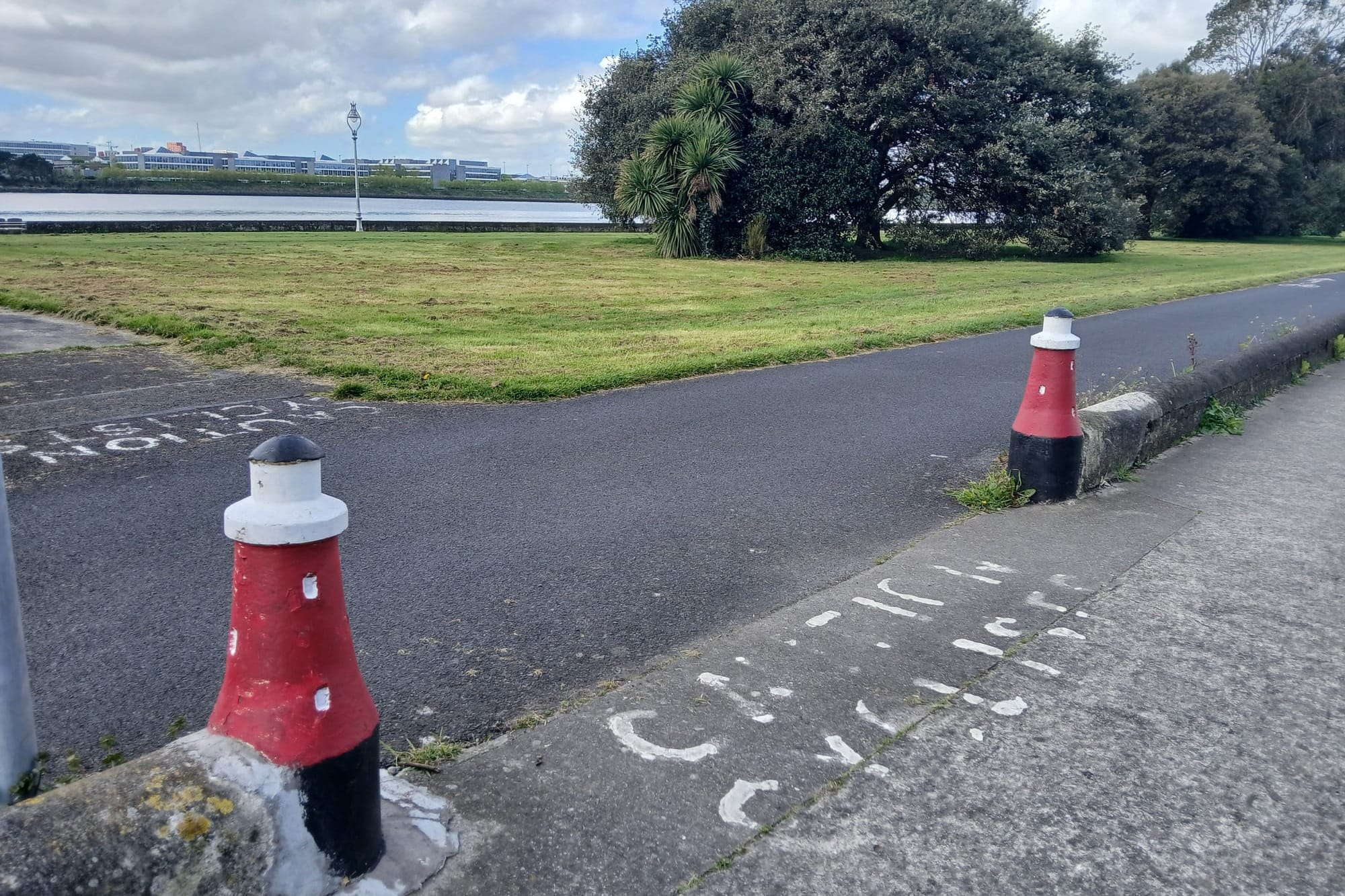
Also, a “beaver dam” – a big snaky balloon that can be filled with water to create a wall, basically – would be used at Vernon Avenue “to run between the end of the existing kerbside wall in front of the pumping station as far as the kerbside wall at the bus stop/car park”, the update says.
At the Clontarf Baths, where there’s a break in the roadside wall to let drivers pull into the semi-circular driveway, there would be additional defences too, the update says.
“The existing low wall that runs from the inside of the cycle track towards The Baths will be raised by approx 300mm or replaced byJersey Barriers or replaced with a planted berm,” it says.
“The gap across the sea side pedestrian walkway between this defence and The Baths will be filled with the wooden or aluminium barriers,” it says.
Jersey barriers are the modular cement walls – used along highways in New Jersey and elsewhere in the States – that the council has installed along the Clontarf Road, down near Hollybrook Road, to replace the big yellow sandbags that had been there for years.
Sitting at the picnic table nearly across Clontarf Road from the Baths on Monday, O’Brien said that the beaver dam, and the slats, would take a lot of manual labour to install and remove each time.
The residents association is proposing an alternative that would be more costly, and take longer to build, but then require less effort to use each time a storm approached and the waters began to rise, she says.
It’s just a wall.
A nice-looking stone wall, about 750mm to 850mm tall, on the road side of the promenade, from end to end.
Where gaps would be required to allow cars into car parks, for example, there’d be (flood) gates that local residents could walk over close without too much effort.
The low-ish height of the wall is key, says O’Brien.
Residents had previously opposed, successfully, plans for a higher wall, on the grounds that it would hide people at the seafront from the street, the houses, the shops – leaving sitters, walkers, runners, and cyclists isolated and less safe, O’Brien said.
But the council has installed a lower wall, and has now proposed more low-ish wall.
The Jersey barriers near Hollybrook Road are about 800mm tall, and the council has recently planted a holly hedge next to them, suggesting that the plan is to leave them there a good long while.
So if a low-ish wall is good enough for the council now, the residents association would like to propose one too, O’Brien said.
The Long Wall would take longer than what the council is proposing to get in before the next storm season, she said.
“It would cost more and it would take longer,” she said.
In the longer term, the council is still working, slowly, on plans for stronger permanent flood defences along the promenade in Clontarf.
In the meantime, though, Uisce Éireann is moving forward more quickly with its own plans for a big water main underneath the promenade.
“Works on the Clontarf Promenade between Hollybrook Road and The Woodenbridge are expected to commence in 2027,” its project webpage says.
O’Brien says she is worried that the placement of this water main underneath the promenade – either closer to the sea wall or closer to the road, could close down options for the eventual permanent flood defences.
For example, she said, one possibility is to raise the seawall, and have a terraced promenade rising from the road to the newly heightened seawall.
That way people running along the seawall would still be visible from the road, the homes, and the shops – and thus safer.
That’s only one idea, there are lots of other possibilities, O’Brien said. “We do feel that this can be solved without destroying the amenity and without damaging public safety.”
But if Uisce Éireann puts the pipe closer to the sea wall, the council couldn’t pile a bunch of earth on top to raise that side of the promenade – because then how would the water company reach the pipe underneath for maintenance and repairs? O’Brien says.
“We just want to make sure there are as many options available as possible when we get to the design,” she said.
There’s no design for the permanent flood defences yet, said Cooney, last Thursday.
But, said O’Brien, “Uisce Éíreann say, ‘We can’t wait for you.’”
Note: The Clontarf Residents Association is running a survey, asking residents their views on the council’s temporary proposal, the association’s alternative, and the longer-term future of flood defence on the promenade.

Although, even though the OPW lists these rents as payable, some of the named beneficiaries say they haven't been getting them.

They're set to back the creation of a special purpose vehicle he's been picked to head, which is meant to play a major role in regenerating the city centre – but how major is in dispute.

Social tenants who live in the private Liberties complex Grand Canal Harbour say they're not allowed to use many of the common facilities there.

Gone is the hardman shtick, the macho bravado once associated with hip hop, rapper and producer Michael Ward, who goes by Mickzart. “We’re after something true.”